Blog
Bayes Factors for SEM at IMPS 2026 in Seoul
Last week we presented our work on computing Bayes factors for structural equation models at the International Meeting of the Psychometric Society in Seoul — a project together with Edgar Merkle and Eric-Jan Wagenmakers.
The usual shortcut for Bayes factors in SEM is the BIC difference, which quietly commits you to a unit-information prior centered at the MLE. It works, but the prior is hidden and essentially impossible to change. The alternative we propose is a lavaan → blavaan → bridgesampling workflow: fit the model to get MLEs and standard errors, specify univariate UI-type priors explicitly, then estimate the marginal likelihoods by bridge sampling. In a small simulation the baseline UI priors reproduce the BIC Bayes factor closely, and tightening the prior or adding a directional constraint sharpens the evidence for the data-generating model — which is exactly the point: with the prior out in the open, substantive information can actually be put to work.
Worth emphasizing: none of this waits on new software. The workflow runs today on lavaan, blavaan, and bridgesampling as they already exist on CRAN, and our annotated code is on OSF — so anyone fitting SEMs in R can compute these Bayes factors now. It has also proven extendable: robust mixture priors, which compare models under a diffuse and an informative prior at once, and Bayesian model averaging over models and priors both build directly on the same three steps. What is still ahead is broader validation and a point-and-click implementation in JASP. Preprint: https://doi.org/10.31234/osf.io/pt2bc_v1, code at https://osf.io/wyuqd/. Slides are on the talks page.
The usual shortcut for Bayes factors in SEM is the BIC difference, which quietly commits you to a unit-information prior centered at the MLE. It works, but the prior is hidden and essentially impossible to change. The alternative we propose is a lavaan → blavaan → bridgesampling workflow: fit the model to get MLEs and standard errors, specify univariate UI-type priors explicitly, then estimate the marginal likelihoods by bridge sampling. In a small simulation the baseline UI priors reproduce the BIC Bayes factor closely, and tightening the prior or adding a directional constraint sharpens the evidence for the data-generating model — which is exactly the point: with the prior out in the open, substantive information can actually be put to work.
Worth emphasizing: none of this waits on new software. The workflow runs today on lavaan, blavaan, and bridgesampling as they already exist on CRAN, and our annotated code is on OSF — so anyone fitting SEMs in R can compute these Bayes factors now. It has also proven extendable: robust mixture priors, which compare models under a diffuse and an informative prior at once, and Bayesian model averaging over models and priors both build directly on the same three steps. What is still ahead is broader validation and a point-and-click implementation in JASP. Preprint: https://doi.org/10.31234/osf.io/pt2bc_v1, code at https://osf.io/wyuqd/. Slides are on the talks page.
Methodological Metamorphosis: Version 2 Is Up
I just posted version 2 of “A Methodological Metamorphosis” on PsyArXiv. It folds in the mid-tier journal comparison I presented at APS in Barcelona — six additional journals, 13,104 more coded articles — so the manuscript itself now matches the full story from the talk instead of just the top-tier analysis. Updated preprint: https://doi.org/10.31234/osf.io/ck3js_v2.
A Methodological Metamorphosis: Bayesian Inference and Open Science in Psychology
Last week I presented at the APS Annual Convention in Barcelona, as part of the symposium "The Past, Present, and Future of Scientific Reform." The talk summarized a large collaborative project tracking the adoption of Bayesian inference, preregistration, and open data across 28,745 empirical articles from 12 psychology journals spanning 2004–2024 — the work of 44 co-authors and one LLM.
In the top-tier journals (e.g., Psychological Science, Journal of Experimental Psychology: General), by 2024 about 73% of articles shared open data, 40% were preregistered, and 25% used Bayesian inference. All three practices were essentially absent before 2010 and took off sharply after 2015.
A key addition to the project — prompted by peer review — was a second sample of six mid-tier journals (including Psychological Reports, International Journal of Psychology, and Journal of Applied Social Psychology), covering another 13,104 articles coded entirely by LLM. The contrast is striking: open data sits around 40%, preregistration around 18%, and Bayesian inference around 16% in mid-tier journals — roughly half the rates seen in top-tier outlets. Most mid-tier journals remain below 25% on all three practices.
The most interesting exception is Memory & Cognition, which matches top-tier journals on open data (~80%) and Bayesian adoption (~30%), despite its mid-tier classification. That outlier points to journal policy as a stronger driver of reform adoption than prestige alone.
Psychology is on a genuinely promising path — the metamorphosis is real — but the gap between journal tiers makes clear that open science practices have not diffused evenly across the field. Preprint: https://doi.org/10.31234/osf.io/ck3js_v1.
In the top-tier journals (e.g., Psychological Science, Journal of Experimental Psychology: General), by 2024 about 73% of articles shared open data, 40% were preregistered, and 25% used Bayesian inference. All three practices were essentially absent before 2010 and took off sharply after 2015.
A key addition to the project — prompted by peer review — was a second sample of six mid-tier journals (including Psychological Reports, International Journal of Psychology, and Journal of Applied Social Psychology), covering another 13,104 articles coded entirely by LLM. The contrast is striking: open data sits around 40%, preregistration around 18%, and Bayesian inference around 16% in mid-tier journals — roughly half the rates seen in top-tier outlets. Most mid-tier journals remain below 25% on all three practices.
The most interesting exception is Memory & Cognition, which matches top-tier journals on open data (~80%) and Bayesian adoption (~30%), despite its mid-tier classification. That outlier points to journal policy as a stronger driver of reform adoption than prestige alone.
Psychology is on a genuinely promising path — the metamorphosis is real — but the gap between journal tiers makes clear that open science practices have not diffused evenly across the field. Preprint: https://doi.org/10.31234/osf.io/ck3js_v1.
Bayes Factors for Structural Equation Models with Bridge Sampling and blavaan
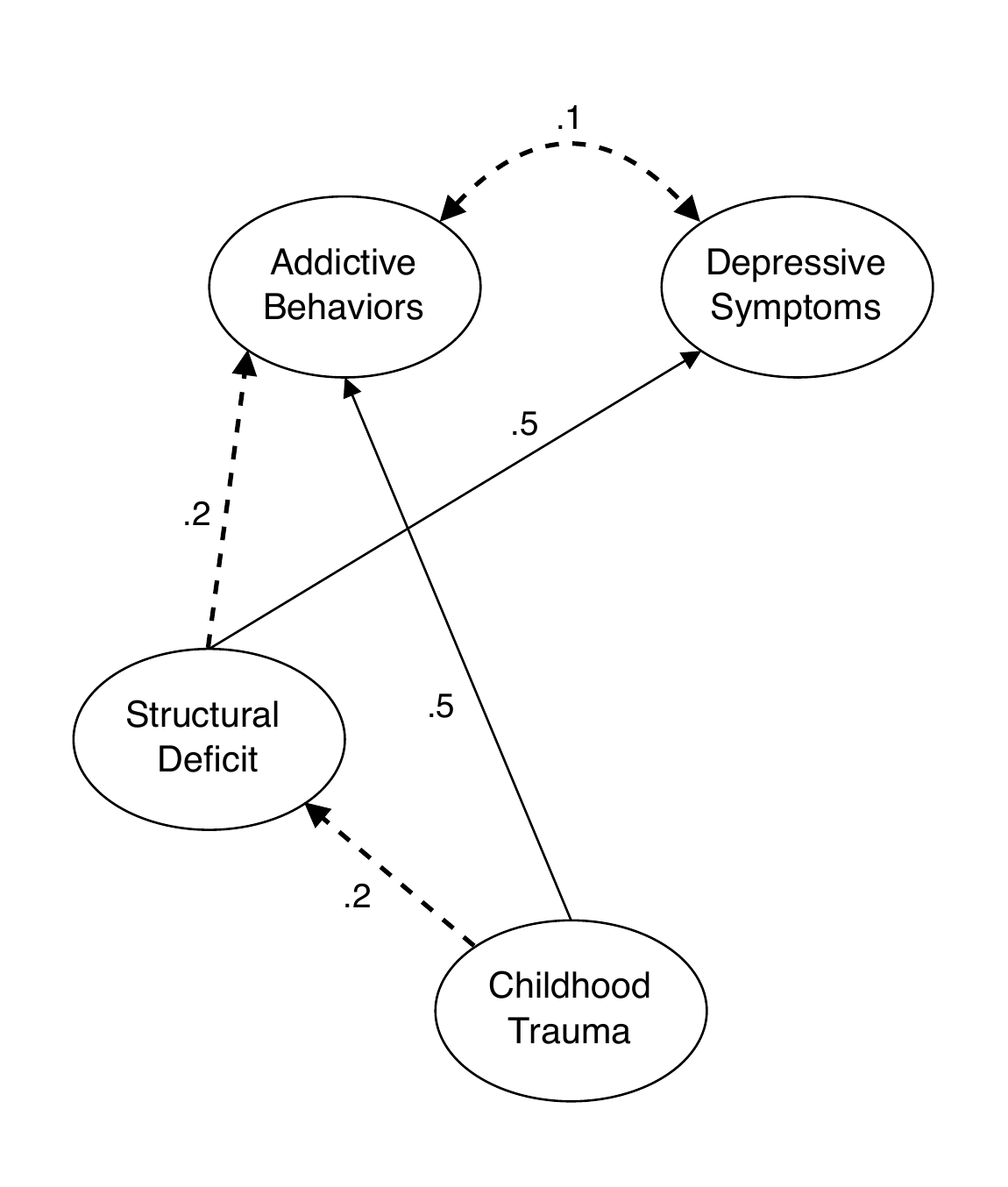 I recently completed a very big chunk of my WB fellowship project. The output: A new paper on Bayesian model comparison in structural equation modeling (SEM). The central question is simple: how can we compute Bayes factors for SEMs in a way that is practical, transparent, and flexible enough to incorporate substantive prior information?
For the curious: The preprint is available at https://doi.org/10.31234/osf.io/pt2bc_v1.
I recently completed a very big chunk of my WB fellowship project. The output: A new paper on Bayesian model comparison in structural equation modeling (SEM). The central question is simple: how can we compute Bayes factors for SEMs in a way that is practical, transparent, and flexible enough to incorporate substantive prior information?
For the curious: The preprint is available at https://doi.org/10.31234/osf.io/pt2bc_v1.